Vitamin B2
Riboflavin
Also known as: Riboflavin, Vitamin G (historical), Lactoflavin, Ovatoflavin, Hepatoflavin
Vitamin B2 (riboflavin) is a water-soluble vitamin essential for energy production, cellular function, and growth. It serves as a precursor for two major coenzymes (FMN and FAD) that participate in numerous metabolic reactions. Riboflavin has gained attention for its potential role in migraine prevention.
Introduction
Riboflavin, also known as vitamin B2, is a water-soluble B vitamin that plays a fundamental role in human metabolism. It is an essential component of two major coenzymes: flavin mononucleotide (FMN) and flavin adenine dinucleotide (FAD), which participate in over 100 different enzymatic reactions throughout the body.
The primary function of riboflavin is in energy metabolism. FMN and FAD serve as electron carriers in the electron transport chain, the final pathway of cellular respiration that generates ATP. These coenzymes are also essential for the metabolism of carbohydrates, fats, and proteins, helping convert food into usable energy. Without adequate riboflavin, cells cannot efficiently produce the energy needed for their functions.
Beyond energy production, riboflavin plays crucial roles in cellular growth and development. It is required for the proper functioning of many cellular processes, including DNA repair, synthesis of other vitamins (such as conversion of vitamin B6 to its active form), and maintenance of healthy red blood cells. Riboflavin also helps maintain healthy mucous membranes in the digestive tract and supports normal immune function.
Riboflavin has been extensively studied for its potential role in migraine prevention. Clinical trials have shown that high-dose riboflavin supplementation (typically 400 mg/day) can reduce the frequency and duration of migraine attacks in some individuals. The mechanism is thought to involve improved mitochondrial function in brain cells.
As a water-soluble vitamin, riboflavin is not stored in significant amounts in the body and must be consumed regularly through diet. Excess riboflavin is excreted in urine, often causing a characteristic bright yellow color. Deficiency, known as ariboflavinosis, is uncommon in developed countries but can occur with poor diet, alcoholism, or certain medical conditions.
Main Benefits
Essential for energy metabolism as a precursor to FMN and FAD coenzymes, which participate in the electron transport chain and ATP production.
May help prevent migraine headaches when taken at high doses (400 mg/day), reducing frequency and duration of attacks.
Supports eye health and may help prevent cataracts and other age-related eye conditions through its role in antioxidant defense.
Essential for maintaining healthy skin, hair, and nails through its role in cellular growth and tissue repair.
Required for proper function of the nervous system; deficiency can cause peripheral neuropathy and other neurological symptoms.
Mechanism of Action
Riboflavin's primary mechanism of action involves its conversion to two active coenzymes: flavin mononucleotide (FMN) and flavin adenine dinucleotide (FAD). These coenzymes function as electron carriers in numerous oxidation-reduction reactions throughout the body.
In energy metabolism, FAD and FMN are essential components of the electron transport chain located in the inner mitochondrial membrane. They accept electrons from NADH and FADH2 and transfer them through a series of protein complexes ultimately to oxygen, generating ATP through oxidative phosphorylation. This process provides the majority of cellular energy in aerobic organisms.
Riboflavin coenzymes also participate directly in the metabolism of macronutrients. FAD is required for the beta-oxidation of fatty acids, the citric acid cycle (as a component of succinate dehydrogenase), and the catabolism of several amino acids. FMN is a cofactor for the enzyme that converts vitamin B6 (pyridoxine) to its active form (pyridoxal phosphate), linking riboflavin status to vitamin B6 function.
The mechanism behind riboflavin's effect on migraines is thought to involve mitochondrial function. Brain cells have high energy demands and abundant mitochondria. Riboflavin supplementation may enhance mitochondrial energy metabolism, potentially reducing susceptibility to migraine attacks. Some research suggests that individuals with migraines may have subtle mitochondrial dysfunction that responds to riboflavin supplementation.
Riboflavin also has antioxidant properties through its role in the glutathione redox cycle. FAD is required for the enzyme glutathione reductase, which maintains glutathione in its reduced (active) form. Glutathione is a major intracellular antioxidant that protects cells from oxidative damage.
As a water-soluble vitamin, riboflavin is absorbed in the upper gastrointestinal tract through active transport at low concentrations and passive diffusion at higher concentrations. It circulates in the bloodstream bound to albumin and other proteins. The body has limited storage capacity for riboflavin, with small amounts found in the liver, heart, and kidneys. Excess riboflavin is rapidly excreted unchanged in urine.
Natural Sources
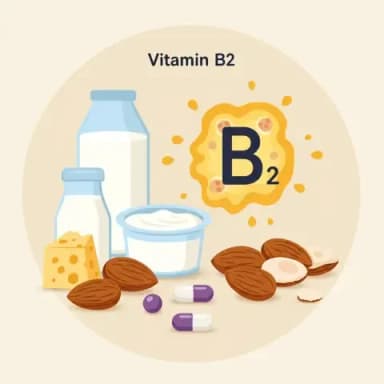
Riboflavin is found in a variety of foods, with particularly high concentrations in organ meats, dairy products, and fortified grains. It is stable during cooking but can be destroyed by exposure to light, which is why milk is often sold in opaque containers.
Examples:
Beef liver
Fortified breakfast cereals
Fortified bread and pasta
Milk and yogurt
Cheese
Eggs
Almonds
Lean meats
Salmon
Chicken breast
Mushrooms
Spinach
Widely available in many common foods; fortification of grains and dairy products makes deficiency rare in developed countries.
Deficiency Symptoms
Riboflavin deficiency, known as ariboflavinosis, typically occurs alongside other B vitamin deficiencies. It affects the skin, mucous membranes, and eyes. Deficiency is uncommon in developed countries due to food fortification but can occur with poor diet, alcoholism, or malabsorption conditions.
Common Symptoms:
Cracks and sores at corners of mouth (angular cheilitis)
Swollen, sore throat
Inflamed, magenta-colored tongue (glossitis)
Red, itchy eyes and photophobia
Skin rashes, especially on face and genitals
Fatigue and weakness
Peripheral neuropathy
Anemia
Depression
Night blindness
Rare in developed countries due to food fortification; more common in developing countries and among individuals with alcoholism or restrictive diets.
Can cause significant discomfort and functional impairment but is rarely life-threatening; usually reversible with supplementation.
Recommended Daily Intake
Riboflavin requirements are based on the amount needed to maintain normal functional levels of the vitamin in the body. Needs increase during periods of growth, pregnancy, and lactation. Athletes and very active individuals may have slightly higher requirements.
Reference Values:
| Infants (0–6 months) | 0.3 mg/day |
| Infants (7–12 months) | 0.4 mg/day |
| Children (1–3 years) | 0.5 mg/day |
| Children (4–8 years) | 0.6 mg/day |
| Children (9–13 years) | 0.9 mg/day |
| Teen boys (14–18 years) | 1.3 mg/day |
| Teen girls (14–18 years) | 1.0 mg/day |
| Adult men (19+ years) | 1.3 mg/day |
| Adult women (19+ years) | 1.1 mg/day |
| Pregnant women | 1.4 mg/day |
| Lactating women | 1.6 mg/day |
Sources for RDI/AI:
- https://ods.od.nih.gov/factsheets/Riboflavin-Consumer/
- https://ods.od.nih.gov/factsheets/Riboflavin-HealthProfessional/
Athletes and very physically active individuals may have slightly higher requirements. Individuals on certain medications (including some antidepressants and oral contraceptives) may need increased riboflavin.
Effectiveness for Specific Focuses
Essential coenzyme component for ATP production through the electron transport chain; fundamental to cellular energy metabolism.
Important for eye health; deficiency causes photophobia and eye fatigue; may help protect against cataracts.
Clinical evidence supports high-dose riboflavin (400 mg/day) for migraine prevention; reduces frequency and duration of attacks.
Deficiency causes skin problems (cracked lips, rashes); important for cellular growth and tissue repair throughout the body.
Required for DNA repair, red blood cell formation, and conversion of vitamin B6 to its active form; supports overall metabolic and cellular function.
Safety Information
Potential Side Effects
Bright yellow urine (harmless, due to excess excretion)
Mild digestive upset at very high doses
Itching
Numbness or tingling (rare, at very high doses)
Contraindications
Riboflavin transporter deficiency (requires specialized medical management)
Overdose Information
Very low risk; water-soluble vitamin with no established upper limit. Excess is rapidly excreted in urine. No toxicity reported from oral intake.
No toxic effects have been reported from oral riboflavin intake. The only noticeable effect of excess consumption is bright yellow-orange urine color, which is harmless and results from excess riboflavin being excreted unchanged.
Documented Overdose Symptoms:
Bright yellow-orange urine (harmless)
No upper limit (UL) has been established for riboflavin due to lack of toxicity data. The body efficiently excretes excess riboflavin in urine. Very high doses (400 mg/day used in migraine studies) have been well-tolerated.
Interactions
Drug Interactions:
Tricyclic antidepressants - may interfere with riboflavin metabolism
Oral contraceptives - may increase riboflavin requirements
Antipsychotic medications - may affect riboflavin status
Probenecid - decreases absorption of riboflavin
Doxorubicin - riboflavin may interfere with this chemotherapy drug
Moderate risk; several medications can affect riboflavin status or absorption, but clinical significance is usually minor.
Other Supplement Interactions:
Other B vitamins - often work synergistically; B-complex supplements common
Iron - riboflavin may enhance iron absorption
Vitamin B6 - riboflavin is required to convert B6 to its active form
Folate - metabolic interactions in one-carbon metabolism
Generally beneficial interactions with other B vitamins; minimal risks.
Riboflavin is generally considered safe with very low toxicity risk. High doses used for migraine prevention (400 mg/day) should be taken under medical supervision. Individuals with riboflavin transporter deficiency require specialized medical management.
Forms and Bioavailability
Riboflavin supplements are available as riboflavin itself or as riboflavin 5'-phosphate (also called flavin mononucleotide or FMN). Both forms are well-absorbed. Riboflavin is the most common form in supplements.
Riboflavin (Free form)
The standard supplemental form. Well-absorbed in the upper gastrointestinal tract. Must be converted to FMN and FAD in the body to become active.
Good bioavailability; efficiently absorbed and converted to active coenzymes in the body.
Most common and least expensive form. Used in all clinical trials for migraine prevention.
Riboflavin 5-Phosphate (FMN)
The phosphorylated form of riboflavin, already one step closer to the active coenzyme form. May be slightly better absorbed in some individuals.
Slightly better bioavailability as it is already in an activated form; requires less metabolic conversion.
Often marketed as "activated" or "coenzymated" riboflavin. More expensive than standard riboflavin.
Riboflavin in B-Complex
Riboflavin combined with other B vitamins in balanced formulations. May provide synergistic benefits.
Good bioavailability; combination with other B vitamins may enhance overall B vitamin status.
Common in multivitamins and B-complex supplements. Often preferred for general supplementation over isolated riboflavin.
Warnings & Suitability
Did You Know...?
Riboflavin gets its name from "ribose" (the sugar in its structure) and "flavin" (from Latin "flavus" meaning yellow), referring to its characteristic yellow color.
Excess riboflavin turns urine bright yellow-orange. This is harmless and actually indicates the body has received more than it needs.
Riboflavin is destroyed by light, which is why milk is typically sold in opaque or cardboard containers rather than clear glass bottles.
In the 1920s and 1930s, riboflavin was called "vitamin G" before the modern nomenclature was established.
General Scientific Sources
Tags
Content Verification
Last Medical Review: 2/13/2026
Reviewed by: Editorial Team