
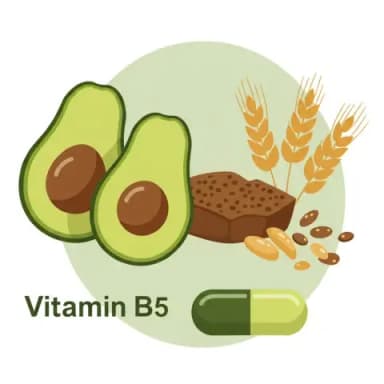
Vitamin B5
Pantothenic acid
Also known as: Pantothenic acid, Pantothenate, D-pantothenic acid, Pantethine, Coenzyme A precursor
Vitamin B5 (pantothenic acid) is an essential water-soluble vitamin required for synthesizing coenzyme A, a critical molecule for energy metabolism and fatty acid synthesis.
Introduction
Vitamin B5, also known as pantothenic acid, is an essential water-soluble B vitamin discovered in 1933. Its name derives from the Greek word "pantothen," meaning "from everywhere," because it is found in virtually all foods.
The primary function of vitamin B5 is as a component of coenzyme A (CoA), one of the most important molecules in metabolism. CoA is essential for:
- Converting carbohydrates, fats, and proteins into usable energy
- Synthesizing fatty acids, cholesterol, and steroid hormones
- Detoxifying harmful substances in the liver
- Synthesizing the neurotransmitter acetylcholine
Because pantothenic acid is so widely distributed in foods, pure dietary deficiency is extremely rare. However, it can occur in severe malnutrition or alongside other B vitamin deficiencies.
Pantethine, a disulfide form of pantothenic acid, has been studied for its potential to lower blood lipids, particularly in people with high cholesterol. Some research suggests it may reduce LDL cholesterol and triglycerides while raising HDL cholesterol.
Topically, pantothenic acid (as panthenol or dexpanthenol) is widely used in skincare and haircare products for its moisturizing and healing properties. It is a common ingredient in cosmetics and wound-healing ointments.
Main Benefits
Essential for coenzyme A synthesis; CoA is required for all energy metabolism and fatty acid oxidation.
Supports synthesis of fatty acids, cholesterol, and steroid hormones including cortisol and sex hormones.
Pantethine form may help lower LDL cholesterol and triglycerides while raising HDL cholesterol.
Required for acetylcholine synthesis, important for nerve function and muscle contraction.
Topical panthenol promotes skin healing, hydration, and barrier function; used in wound care.
Mechanism of Action
Pantothenic acid's biological activity centers on its role as a structural component of coenzyme A (CoA):
Coenzyme A Formation: Pantothenic acid is phosphorylated to form 4'-phosphopantetheine, which then combines with cysteine and ATP to form CoA. CoA contains a reactive thiol (-SH) group that forms thioester bonds with acyl groups.
Energy Metabolism: CoA accepts acetyl groups from pyruvate (from glucose), fatty acids, and amino acids, forming acetyl-CoA. This acetyl-CoA enters the Krebs cycle for ATP production. Without adequate CoA, cells cannot extract energy from macronutrients.
Fatty Acid Metabolism: CoA is essential for both fatty acid synthesis and beta-oxidation (fatty acid breakdown). It activates fatty acids for transport into mitochondria.
Cholesterol and Steroid Synthesis: All steroid hormones (cortisol, aldosterone, testosterone, estrogen, progesterone) are synthesized from cholesterol via pathways requiring CoA.
Detoxification: CoA conjugates with drugs and toxins in the liver, making them more water-soluble for excretion.
Neurotransmitter Synthesis: Pantothenic acid is required for synthesizing acetyl-CoA, which combines with choline to form acetylcholine - a critical neurotransmitter for memory, learning, and muscle activation.
Pantethine works differently - it is the disulfide form of pantetheine and can be converted directly to CoA without the usual enzymatic steps. It also has independent effects on lipid metabolism, possibly through modulating HMG-CoA reductase activity.
Natural Sources
Pantothenic acid is widely distributed in foods. Its name literally means "from everywhere." Good sources include animal tissues, whole grains, and legumes.
Examples:
Chicken and beef liver
Chicken meat
Beef
Eggs
Avocado
Mushrooms
Whole grains
Legumes (lentils, split peas)
Sunflower seeds
Milk and yogurt
Sweet potatoes
Found in virtually all foods; deficiency extremely rare; no special dietary planning needed; only at risk with severe malnutrition.
Deficiency Symptoms
Pure pantothenic acid deficiency is extremely rare but causes generalized symptoms affecting multiple systems. It was experimentally induced in volunteers.
Common Symptoms:
Fatigue and generalized weakness
Irritability and restlessness
Sleep disturbances
Nausea and abdominal cramps
Numbness and burning in hands and feet (paresthesia)
Impaired wound healing
Upper respiratory infections
Extremely rare due to widespread availability in foods; only observed in severe malnutrition or experimental conditions.
Causes generalized metabolic dysfunction; affects energy production and multiple organ systems; reversible with supplementation.
Recommended Daily Intake
AI (Adequate Intake) established: adults 5 mg/day. Requirements increase slightly during pregnancy and lactation. No established RDA due to lack of data on average requirements.
Reference Values:
| Adult men | 5 mg/day (AI) |
| Adult women | 5 mg/day (AI) |
| Pregnancy | 6 mg/day (AI) |
| Lactation | 7 mg/day (AI) |
| Therapeutic doses (pantethine) | 600-900 mg/day |
Sources for RDI/AI:
- https://ods.od.nih.gov/factsheets/PantothenicAcid-HealthProfessional/
- https://www.ncbi.nlm.nih.gov/books/NBK563233/
Therapeutic doses for cholesterol management use pantethine, not pantothenic acid. Take pantethine in divided doses (2-3 times daily) for best effect.
Effectiveness for Specific Focuses
Essential for CoA and energy metabolism; deficiency causes fatigue; no proven energy boost in non-deficient individuals.
Pantethine form may improve lipid profiles; supports overall metabolism; limited evidence for metabolic enhancement.
Pantethine may improve cholesterol levels; supports lipid metabolism; not a primary cardiovascular supplement.
Topical panthenol widely used for skin healing and hydration; oral benefits less established.
Required for acetylcholine synthesis; deficiency affects nerve function; limited evidence for cognitive enhancement.
Safety Information
Potential Side Effects
Very rare diarrhea at extremely high doses
Potential bleeding risk at very high doses (rare case reports)
Contraindications
Hemophilia or bleeding disorders (caution with very high doses)
Overdose Information
No established UL; water-soluble with renal excretion; no toxicity observed at any tested dose up to 10 g/day.
One of the safest vitamins. No adverse effects reported even at megadoses.
Interactions
Drug Interactions:
Blood thinners (theoretical concern at very high doses)
Minimal interactions; very safe with medications.
Other Supplement Interactions:
Other B vitamins - synergistic (B-complex preferred)
Choline - both support acetylcholine synthesis
Very safe with all supplements; B-complex often preferred.
Extremely safe vitamin with no significant warnings. Pantethine for cholesterol should be used under medical supervision if also taking cholesterol medications.
Forms and Bioavailability
Pantothenic acid is available as calcium pantothenate or sodium pantothenate. Pantethine is a different form with specific lipid-lowering effects.
Calcium Pantothenate
Most common supplemental form; stable; well-absorbed; calcium salt of pantothenic acid.
Well-absorbed; stable form; standard for supplements and food fortification.
Most common in supplements and multivitamins. Cost-effective and reliable.
Sodium Pantothenate
Alternative salt form; more soluble than calcium salt; similar bioavailability.
Comparable bioavailability to calcium form; used in some liquid formulations.
Less common than calcium form. Used when sodium salt is preferred for solubility.
Pantethine
Disulfide dimer of pantetheine; converted directly to CoA; lipid-lowering effects independent of standard vitamin function.
Better bioactivity for lipid metabolism; direct CoA precursor; clinically studied for cholesterol.
Use this form specifically for cholesterol/triglyceride management. Not interchangeable with regular pantothenic acid for lipid effects.
Panthenol (Dexpanthenol)
Alcohol form of pantothenic acid; converted to acid in body; used topically and orally.
Well-converted to active form; preferred for topical use; stable in formulations.
Common in skincare products and wound-healing preparations. Can be used orally but pantothenate forms more common.
Warnings & Suitability
Did You Know...?
The name "pantothenic acid" comes from Greek "pantothen" meaning "from everywhere" because it is found in virtually all foods.
Coenzyme A, which requires pantothenic acid, is involved in approximately 4% of all known enzymatic reactions in the body.
Panthenol, the alcohol form of B5, is one of the most widely used ingredients in cosmetics due to its moisturizing and healing properties.
Royal jelly, the substance that turns a regular bee into a queen bee, contains extremely high concentrations of pantothenic acid.
General Scientific Sources
Tags
Content Verification
Last Medical Review: 2/13/2026
Reviewed by: Editorial Team