
Medical Disclaimer: This information is for educational purposes only and is not intended as medical advice. Always consult a qualified healthcare provider before starting any supplement, especially if you have a health condition or take medications.
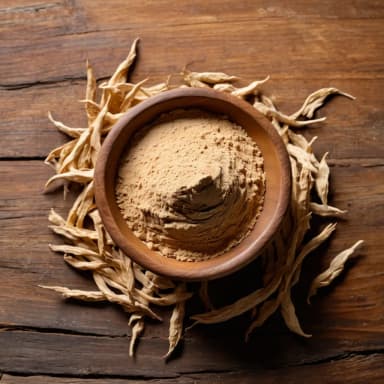
Ashwagandha
Withania somnifera
Also known as: Indian Ginseng, Winter Cherry, Ajagandha, KSM-66, Sensoril, Shoden
Ashwagandha is one of the most important herbs in Ayurvedic medicine, classified as a rasayana (rejuvenative). Modern clinical research confirms its benefits for stress reduction, anxiety, sleep quality, and hormonal health in men.
Introduction
Ashwagandha (Withania somnifera) is a small evergreen shrub native to India, the Middle East, and parts of Africa. Its name comes from Sanskrit, combining "ashva" (horse) and "gandha" (smell), referring to both the root's horse-like odor and the traditional belief that consuming it gives the strength of a horse. It has been a cornerstone of Ayurvedic medicine for over 3,000 years.
In Ayurveda, ashwagandha is classified as a "rasayana"—a rejuvenative tonic that promotes longevity, vitality, and overall health. Traditional uses include strengthening the immune system, improving energy and vitality, enhancing memory and cognitive function, supporting reproductive health, and promoting restful sleep. It was traditionally used to help people recover from illness and debility.
Modern scientific research has validated many of these traditional uses through rigorous clinical trials. Ashwagandha is now one of the most extensively studied adaptogenic herbs, with multiple randomized controlled trials demonstrating its effectiveness for stress and anxiety reduction, cortisol lowering, and improving quality of life in stressed individuals.
The herb contains a group of bioactive compounds called withanolides, particularly withaferin A and withanolide D, which are believed responsible for many of its therapeutic effects. Different commercial extracts standardize for different withanolide concentrations:
- KSM-66: Full-spectrum root extract with 5% withanolides, the most clinically studied form
- Sensoril: Root and leaf extract with 10% withanolides
- Shoden: Highly concentrated extract with 35% withanolides
Research has shown particular promise for ashwagandha in several areas:
Stress and Anxiety: Multiple RCTs demonstrate significant reductions in perceived stress, anxiety scores, and cortisol levels. Effects typically appear within 2-4 weeks.
Sleep Quality: Clinical trials show improvements in sleep onset latency, total sleep time, and sleep efficiency, particularly in people with insomnia or stress-related sleep disturbances.
Testosterone and Male Health: Studies in men show increases in testosterone, DHEA-S, and improvements in sperm quality parameters. Particularly beneficial for men with stress-related hormonal imbalances.
Physical Performance: Research demonstrates improvements in muscle strength, muscle size, and recovery in men engaging in resistance training, likely mediated through testosterone increases and reduced cortisol.
Cognitive Function: Preliminary evidence suggests benefits for executive function, attention, and information processing speed.
The adaptogenic effects of ashwagandha make it particularly suitable for modern lifestyles characterized by chronic stress, poor sleep, and high cognitive demands. Unlike sedatives that simply suppress symptoms, ashwagandha appears to help restore normal stress response function and HPA axis balance.
Main Benefits
Significantly reduces perceived stress and anxiety; multiple RCTs show 27-44% reduction in stress scores and 23-28% reduction in cortisol levels.
Improves sleep quality and reduces insomnia; decreases sleep onset latency and increases total sleep time in people with sleep disturbances.
Increases testosterone and DHEA-S in men; 14.7% greater increase in testosterone and 18% greater increase in DHEA-S compared to placebo.
Improves muscle strength, size, and recovery in men undergoing resistance training; increases in bench press and leg extension strength.
Improves sperm quality parameters including count, motility, and morphology in men with stress-related fertility issues.
Preliminary evidence for cognitive enhancement including improved reaction time, executive function, and attention.
Mechanism of Action
Ashwagandha exerts its effects through multiple interconnected mechanisms as an adaptogen, affecting the stress response system, neurotransmission, hormonal balance, and cellular protection:
HPA Axis Modulation: The primary mechanism involves normalization of the hypothalamic-pituitary-adrenal (HPA) axis. Ashwagandha reduces excessive cortisol secretion while maintaining appropriate stress responses. It downregulates cortisol release from the adrenal glands and may reduce cortisol's negative feedback on the hypothalamus.
GABA-mimetic Effects: Withanolides have been shown to interact with GABA receptors, the brain's primary inhibitory neurotransmitter system. This GABAergic activity contributes to the anxiolytic and sleep-promoting effects, similar to but milder than benzodiazepines but without the same dependency risk.
Anti-inflammatory Action: Withaferin A and other withanolides demonstrate potent anti-inflammatory effects through inhibition of NF-kB pathway and reduction of pro-inflammatory cytokines (IL-1β, IL-6, TNF-α). Chronic inflammation is linked to depression and cognitive decline, making this mechanism relevant for multiple benefits.
Antioxidant Neuroprotection: Ashwagandha increases antioxidant enzymes (SOD, catalase, glutathione peroxidase) and reduces oxidative stress markers in the brain. This neuroprotective effect may support cognitive function and protect against neurodegenerative processes.
Acetylcholinesterase Inhibition: Some withanolides inhibit acetylcholinesterase, the enzyme that breaks down acetylcholine. This increases acetylcholine levels, supporting memory, attention, and cognitive function.
Hormonal Effects: In men, ashwagandha appears to support testosterone production through multiple mechanisms: reducing cortisol (which suppresses testosterone), supporting Leydig cell function in the testes, and potentially increasing luteinizing hormone (LH) signaling. The increase in DHEA-S suggests improved adrenal function.
Thyroid Modulation: Ashwagandha may increase thyroid hormone levels (T3 and T4) and enhance T4 to T3 conversion, which could explain some of its energy-enhancing effects. However, this also creates potential interactions with thyroid medications.
Mitochondrial Support: Withanolides may improve mitochondrial function and energy metabolism, contributing to reduced fatigue and improved physical performance.
The broad spectrum of mechanisms explains why ashwagandha benefits multiple seemingly unrelated conditions—all are connected through the stress response, inflammation, and hormonal balance.
Natural Sources
Ashwagandha is native to dry regions of India, the Middle East, and parts of Africa. The roots are the primary medicinal part used, though leaves are also used in some extracts. Not consumed as a food; used exclusively as a medicinal herb.
Examples:
Ashwagandha root (cultivated)
KSM-66 root extract (standardized)
Sensoril root and leaf extract (standardized)
Shoden extract (high concentration)
Dried root powder (traditional)
Not consumed as food; available as standardized extracts (KSM-66, Sensoril) and traditional powders. Quality varies significantly between products.
Recommended Daily Intake
No established RDA. Clinical studies use 240-600 mg daily of standardized extracts (KSM-66, Sensoril, Shoden) or 3-6 g of dried root powder. Effects for stress/anxiety appear within 2-4 weeks; testosterone and muscle effects require 8-12 weeks. KSM-66 (5% withanolides): 300-600 mg/day. Sensoril (10% withanolides): 125-250 mg twice daily.
Effectiveness for Specific Focuses
Strongest clinical evidence; multiple RCTs showing significant stress reduction, cortisol lowering, and sleep quality improvement. Primary indication.
Strong evidence for anxiety reduction; GABA-mimetic and anti-inflammatory mechanisms support mood regulation. Effects comparable to some pharmaceuticals for mild-moderate anxiety.
Strong evidence for testosterone increase, fertility improvement, and muscle strength in men. Particularly effective for stress-related hormonal imbalances.
Good evidence for muscle strength, size, and recovery improvements; testosterone increase likely contributes to anabolic effects.
Preliminary but promising evidence for attention, reaction time, and executive function; cholinergic and neuroprotective mechanisms support potential benefits.
Safety Information
Potential Side Effects
Drowsiness or sedation
Gastrointestinal upset (nausea, diarrhea)
Headache
Dizziness
Increased thyroid hormone levels
Liver enzyme elevations (rare)
Allergic reactions
Contraindications
Pregnancy (contraindicated; may cause miscarriage)
Breastfeeding (insufficient safety data)
Autoimmune conditions (theoretical immunostimulant concern)
Thyroid disorders (may increase thyroid hormones)
Surgery (discontinue 2 weeks before)
Prostate cancer (theoretical hormonal concern)
Overdose Information
Generally well-tolerated; side effects typically mild and dose-related. Very high doses may cause GI upset, drowsiness, or dizziness. No serious toxicity reported at normal doses.
Well-tolerated in clinical trials up to 12 weeks. Some concern about rare liver toxicity cases reported outside clinical settings; monitor for signs of liver issues.
Interactions
Drug Interactions:
Thyroid medications (levothyroxine, Armour) - may enhance effects
Sedatives and CNS depressants (additive drowsiness)
Benzodiazepines (additive effects)
Immunosuppressants (theoretical interaction)
Blood sugar medications (may lower blood sugar)
Blood pressure medications (may lower blood pressure)
Moderate-high concern with thyroid medications; moderate caution with sedatives and diabetes/blood pressure medications. Regular monitoring recommended.
Other Supplement Interactions:
GABA supplements (additive calming effects)
Other adaptogens (additive effects)
Stimulants (may counteract calming effects)
5-HTP or tryptophan (additive serotonergic effects)
Generally compatible with most supplements; caution with other sedating supplements to avoid excessive drowsiness.
DO NOT USE during pregnancy. Use caution with thyroid conditions or medications. May cause drowsiness—avoid driving or operating machinery until you know how it affects you. Rare cases of liver toxicity have been reported; discontinue if you develop jaundice, dark urine, or abdominal pain. Consult healthcare provider before use.
Forms and Bioavailability
Ashwagandha is available in several standardized extracts with different withanolide concentrations. KSM-66 is the most clinically studied full-spectrum root extract. Sensoril includes root and leaf. Shoden is highly concentrated for smaller dosing.
KSM-66 (Full-Spectrum Root Extract)
Standardized to 5% withanolides using only root; retains complete spectrum of root compounds; most extensively clinically studied form.
Gold standard based on clinical evidence; full-spectrum approach preserves synergistic compounds; multiple RCTs demonstrating efficacy.
Most research-backed form for stress, anxiety, testosterone, and muscle strength. Use 300-600 mg daily. Take with food.
Sensoril (Root and Leaf Extract)
Standardized to 10% withanolides; includes both root and leaf compounds; higher concentration.
Higher withanolide concentration allows lower dosing; includes leaf compounds which may contribute different effects; good clinical evidence base.
Use 125-250 mg twice daily. May be more calming/sedating than KSM-66 for some people. Good option for sleep support.
Shoden (Highly Concentrated)
Standardized to 35% withanolides; very concentrated; much lower doses needed.
High bioavailability due to concentration; emerging clinical evidence; cost-effective due to low dosing requirements.
Use 60-240 mg daily. Newer extract with promising preliminary research. May be most cost-effective option.
Traditional Root Powder
Dried and powdered whole root; contains all natural compounds in natural ratios.
Traditional form but variable withanolide content; requires much higher doses; less convenient than extracts.
Use 3-6 g daily. Can be mixed into smoothies or warm milk (traditional). Strong taste that some find unpleasant. Most economical but least convenient.
Warnings & Suitability
Did You Know...?
The name "ashwagandha" literally means "smell of horse" in Sanskrit—referring to both the root's odor and the belief it gives the strength of a horse.
Ashwagandha has been used in Ayurvedic medicine for over 3,000 years. It was traditionally prescribed for people recovering from illness to rebuild strength and vitality.
The KSM-66 extract was developed over 14 years of research and uses a proprietary extraction process that preserves the full spectrum of root compounds while standardizing for withanolides.
In Ayurveda, ashwagandha is classified as a "rasayana"—a category of herbs believed to promote longevity, slow aging, and enhance quality of life.
Studies have shown that ashwagandha can reduce cortisol levels by up to 27-28% in chronically stressed adults—comparable to some pharmaceutical interventions.
General Scientific Sources
Tags
Content Verification
Content created with AI assistance and reviewed for accuracy. Sources are cited throughout the text.
Last Medical Review: 2/25/2026
Reviewed by: Prodata.cc