
Medical Disclaimer: This information is for educational purposes only and is not intended as medical advice. Always consult a qualified healthcare provider before starting any supplement, especially if you have a health condition or take medications.
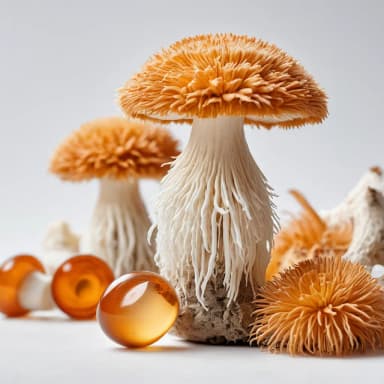
Lion's Mane Mushroom
Hericium erinaceus
Also known as: Yamabushitake, Monkey Head Mushroom, Bearded Tooth Mushroom, Hedgehog Mushroom, Pom Pom Mushroom
Lion's Mane is a medicinal mushroom with neuroprotective properties. It contains unique compounds (hericenones and erinacines) that stimulate nerve growth factor (NGF) synthesis, supporting brain health, cognitive function, and nerve regeneration.
Introduction
Lion's Mane (Hericium erinaceus) is an edible and medicinal mushroom belonging to the tooth fungus group. Native to North America, Europe, and Asia, it grows on hardwood trees and is easily recognizable by its long, shaggy white spines that resemble a lion's mane. It has been used for centuries in Traditional Chinese Medicine and Japanese culinary traditions.
The mushroom gained modern scientific attention due to its unique ability to stimulate nerve growth factor (NGF) synthesis. NGF is a neuropeptide essential for the growth, maintenance, and survival of neurons. Unlike many pharmaceutical approaches to neurological conditions, Lion's Mane appears to support the body's natural neuroregenerative capabilities.
The primary bioactive compounds are hericenones (found in the fruiting body) and erinacines (found in the mycelium). These compounds can cross the blood-brain barrier and have demonstrated neurotrophic effects in preclinical studies. Hericenones were first identified in 1994 as compounds capable of stimulating NGF synthesis, while erinacines represent a more potent class of NGF-inducers isolated from the mycelium.
Clinical research, though still limited, has shown promising results. A landmark 2009 Japanese study found that older adults with mild cognitive impairment showed significant improvements in cognitive function after 16 weeks of Lion's Mane supplementation. However, benefits appeared to diminish after discontinuation, suggesting ongoing supplementation may be necessary for sustained effects.
Beyond cognitive health, Lion's Mane shows potential for peripheral nerve regeneration, mood support, and digestive health. Its traditional uses include supporting gastric health, and modern research has confirmed gastroprotective effects in animal models. The mushroom also exhibits antioxidant, anti-inflammatory, and immunomodulatory properties.
Unlike stimulant-based cognitive enhancers, Lion's Mane does not produce acute effects. Benefits typically develop over 4-16 weeks of consistent use, suggesting it works through structural neuroplastic changes rather than acute neurotransmitter modulation.
Main Benefits
May improve cognitive function and memory in older adults with mild cognitive impairment; clinical trials show improvements in cognitive scale scores after 8-16 weeks of supplementation.
Stimulates nerve growth factor (NGF) synthesis through bioactive compounds hericenones and erinacines; supports neurogenesis and neuronal health.
Shows neuroprotective properties through antioxidant mechanisms, anti-inflammatory effects, and protection against neuronal apoptosis.
May support peripheral nerve regeneration and recovery from nerve injuries; preclinical studies show enhanced myelination and nerve repair.
May reduce symptoms of anxiety and depression; preliminary clinical evidence suggests mood-supporting effects independent of cognitive benefits.
Demonstrates gastroprotective effects; may support digestive health and help protect against gastric ulcers.
Mechanism of Action
Lion's Mane exerts its neurotrophic effects primarily through unique bioactive compounds that stimulate nerve growth factor (NGF) synthesis and support neuronal health:
NGF Stimulation: Hericenones (from fruiting body) and erinacines (from mycelium) cross the blood-brain barrier and stimulate synthesis of NGF in astrocytes and other brain cells. NGF is essential for the growth, maintenance, and survival of cholinergic neurons. Enhanced NGF levels promote neurogenesis, particularly in the hippocampus, and support synaptic plasticity.
Neuroprotection: The mushroom demonstrates multiple neuroprotective mechanisms. It reduces oxidative stress in neurons through antioxidant enzymes and direct free radical scavenging. Anti-inflammatory effects include modulation of microglial activation and reduction of pro-inflammatory cytokines (TNF-α, IL-6, IL-1β) in the brain.
Amyloid and Tau Pathology: Preclinical studies suggest Lion's Mane may inhibit aggregation of beta-amyloid protein and reduce phosphorylation of tau protein, potentially relevant to Alzheimer's disease prevention. These effects may occur through enhancement of autophagy and proteasomal activity.
Myelination Support: Erinacines have been shown to promote myelination and remyelination processes, supporting the protective sheath around nerve fibers. This mechanism is particularly relevant for peripheral nerve regeneration and potentially for demyelinating conditions.
Monoamine Modulation: Animal studies suggest Lion's Mane may modulate serotonergic and dopaminergic pathways, potentially explaining mood-supporting effects. It may increase expression of brain-derived neurotrophic factor (BDNF) in addition to NGF.
Gut-Brain Axis: The mushroom's gastroprotective effects and potential prebiotic properties may influence the gut-brain axis, though this mechanism requires further research.
Unlike acute cognitive enhancers, Lion's Mane requires chronic administration (weeks to months) to produce noticeable effects, consistent with its mechanism of promoting structural neuroplasticity rather than acute neurotransmitter modulation.
Natural Sources
Lion's Mane grows wild on hardwood trees, particularly oak, walnut, beech, and maple. It is found in temperate forests of North America, Europe, and Asia. The mushroom is also cultivated commercially on sawdust substrates or logs. It is edible and has a flavor and texture similar to seafood, particularly crab or lobster.
Examples:
Wild hardwood forests (oak, walnut, beech, maple)
Cultivated mushroom farms
Specialty grocery stores (fresh)
Asian markets
While edible and delicious, fresh Lion's Mane is not commonly available in regular supermarkets; supplements provide more consistent dosing of bioactive compounds.
Recommended Daily Intake
No established RDA. Clinical studies have used various dosing protocols. Typical supplementation ranges from 500-3,000 mg daily of standardized extract. The landmark Japanese study used 3,000 mg daily (divided into three doses). Effects typically require 4-16 weeks to become noticeable.
Effectiveness for Specific Focuses
Strongest evidence base; improves cognitive function in MCI; stimulates NGF; neuroprotective; well-studied nootropic mushroom.
Neuroprotective effects; potential to slow cognitive decline; supports healthy brain aging; limited direct longevity evidence.
Preliminary evidence for anxiety and depression reduction; may improve mood through neurotrophic and anti-inflammatory mechanisms.
Limited direct evidence; may indirectly support stress resilience through neuroprotection; some users report improved sleep quality.
Gastroprotective effects demonstrated in animal studies; traditional use for digestive health; limited human clinical data.
Safety Information
Potential Side Effects
Gastrointestinal upset (nausea, bloating, diarrhea)
Abdominal discomfort
Skin rash or allergic reactions (rare)
Itching
Hypomenorrhea (reduced menstrual flow, rare case report)
Contraindications
Pregnancy and breastfeeding (insufficient safety data)
Bleeding disorders (theoretical anticoagulant concern)
Surgery (discontinue 2 weeks before due to theoretical bleeding risk)
Allergies to mushrooms
Asthma (potential respiratory sensitivity)
Overdose Information
Excellent safety profile; no serious toxicity reported in clinical trials; mild GI effects are the most common side effects.
Very safe with excellent tolerability. GI side effects can be minimized by taking with food. Long-term safety data beyond one year is limited.
Interactions
Drug Interactions:
Anticoagulant/antiplatelet medications (theoretical bleeding risk)
Diabetes medications (may lower blood sugar)
Cholinergic drugs (may enhance effects)
Caution with blood thinners due to theoretical anticoagulant effects; minimal other interactions; generally very safe with medications.
Other Supplement Interactions:
Choline sources - may be synergistic for cognitive function
Other nootropics - may be complementary
Blood-thinning supplements (fish oil, ginkgo) - theoretical additive effect
Synergistic with choline sources; safe combinations with other nootropics; caution with other supplements affecting blood clotting.
Take with meals to reduce GI side effects. Effects take weeks to months to develop - this is not an acute cognitive enhancer. Discontinue use 2 weeks before surgery due to theoretical bleeding risk. Consult healthcare provider if pregnant, breastfeeding, or taking blood-thinning medications.
Forms and Bioavailability
Lion's Mane supplements vary by plant part used and extraction method. Fruiting body extracts contain hericenones, while mycelium extracts contain erinacines. Some products combine both. Hot water or alcohol extraction enhances bioavailability of active compounds.
Fruiting Body Extract (Hot Water)
Contains hericenones and polysaccharides; hot water extraction improves bioavailability of water-soluble compounds.
Standard form with good research support; hericenones effectively extracted with hot water.
Most common form in supplements. Look for products specifying beta-glucan and hericenone content. Typical dose 1,000-3,000 mg daily.
Mycelium Extract
Contains erinacines, which are more potent NGF inducers than hericenones; grown on grain substrate.
Erinacines show stronger NGF stimulation than hericenones in preclinical studies.
Often grown on brown rice or other grains. May contain residual grain biomass. Typical dose 500-1,000 mg daily.
Full Spectrum (Fruiting Body + Mycelium)
Combines hericenones from fruiting body and erinacines from mycelium; comprehensive bioactive compound profile.
Provides complete range of bioactive compounds; synergistic potential between hericenones and erinacines.
Preferred form for comprehensive benefits. Ensure product specifies content of both fruiting body and mycelium.
Dual Extract (Hot Water + Alcohol)
Extracts both water-soluble (polysaccharides) and alcohol-soluble (terpenoids) compounds; maximum bioactive content.
Comprehensive extraction captures full spectrum of bioactive compounds including hericenones, erinacines, and polysaccharides.
Premium extraction method. Alcohol extraction is necessary for optimal terpenoid content. Look for products specifying dual extraction process.
Warnings & Suitability
Did You Know...?
Lion's Mane is not just medicinal - it's a gourmet edible mushroom with a flavor and texture often compared to crab or lobster meat.
The mushroom's cascading white spines can grow up to 40 cm long, truly resembling a lion's mane as it matures.
In traditional Chinese medicine, Lion's Mane was believed to provide "nerves of steel and the memory of a lion" - a remarkably accurate description given modern discoveries about NGF stimulation.
Erinacines from the mycelium are significantly more potent at stimulating NGF than hericenones from the fruiting body - up to 10 times more effective in laboratory studies.
General Scientific Sources
Tags
Content Verification
Content created with AI assistance and reviewed for accuracy. Sources are cited throughout the text.
Last Medical Review: 2/25/2026
Reviewed by: Prodata.cc