
Medical Disclaimer: This information is for educational purposes only and is not intended as medical advice. Always consult a qualified healthcare provider before starting any supplement, especially if you have a health condition or take medications.
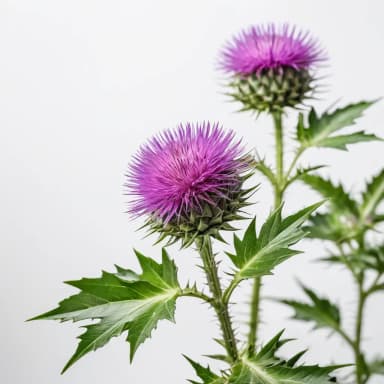
Milk Thistle
Silybum marianum
Also known as: Silymarin, Marian Thistle, St. Mary's Thistle, Holy Thistle, Lady's Thistle, Silybin, Silibinin
Milk thistle is a flowering herb whose active compound silymarin has been used for centuries to support liver health. It provides antioxidant protection, promotes liver cell regeneration, and may help reduce liver enzyme elevations in various liver conditions.
Introduction
Milk thistle (Silybum marianum) is a flowering plant native to the Mediterranean region, recognizable by its distinctive purple flowers and white-veined leaves. The name "milk thistle" comes from the milky white sap that oozes from crushed leaves, while "St. Mary's thistle" references the legend that the white veins were caused by a drop of the Virgin Mary's milk falling on the plant.
The plant has been used medicinally for over 2,000 years, with ancient Greek physician Dioscorides documenting its use for snake bites and liver complaints. Today, it is one of the most widely used herbal supplements for liver health worldwide.
The active component of milk thistle is a complex of flavonolignans collectively called silymarin, comprising 65-80% of the standardized extract. The primary active constituents are:
- Silybin (Silibinin): The most biologically active component (50-70% of silymarin)
- Isosilybin: Second major component
- Silychristin and Silydianin: Minor but active constituents
Silymarin is concentrated in the seeds (fruits) of the plant, which is why supplements use seed extracts rather than aerial parts.
The hepatoprotective mechanisms of silymarin include:
Antioxidant Activity: Silymarin is a potent free radical scavenger that protects liver cells from oxidative damage caused by toxins, alcohol, and metabolic processes.
Cell Membrane Stabilization: It stabilizes hepatocyte (liver cell) membranes, preventing toxins from entering cells and protecting against membrane damage.
Protein Synthesis Stimulation: Silymarin stimulates ribosomal RNA synthesis, promoting liver cell regeneration and repair.
Anti-inflammatory Effects: It inhibits inflammatory mediators including leukotrienes and prostaglandins, reducing liver inflammation.
Antifibrotic Activity: May help prevent or reduce liver fibrosis (scarring) by inhibiting stellate cell activation.
Clinical research shows the strongest evidence for milk thistle in improving liver enzyme levels (ALT, AST, GGT) in non-alcoholic fatty liver disease (NAFLD) and alcoholic liver disease. Results in chronic hepatitis and cirrhosis are more mixed, though some patients do benefit.
It's important to note that while milk thistle supports liver health, it is not a treatment for liver disease and should not replace medical care. Lifestyle modifications (alcohol reduction, weight loss for NAFLD) remain the foundation of liver health.
Main Benefits
Improves liver enzyme levels (ALT, AST, GGT) in non-alcoholic fatty liver disease (NAFLD) and alcoholic liver disease; systematic review supports hepatoprotective effects.
Provides potent antioxidant protection to liver cells, scavenging free radicals and reducing oxidative stress in hepatocytes.
Stabilizes liver cell membranes, protecting hepatocytes from toxin-induced damage and preventing entry of harmful substances.
Stimulates protein synthesis and promotes regeneration of liver cells, supporting recovery from liver injury.
May help prevent or reduce liver fibrosis through antifibrotic effects on hepatic stellate cells.
Supports detoxification processes and may protect against various hepatotoxins including alcohol, medications, and environmental toxins.
Mechanism of Action
Silymarin exerts its hepatoprotective effects through multiple complementary mechanisms targeting liver cell protection, regeneration, and function:
- Free Radical Scavenging: Silymarin is a potent antioxidant that:
- Directly scavenges free radicals (ROS and reactive nitrogen species)
- Chelates free iron and copper that catalyze oxidative reactions
- Increases intracellular glutathione levels (major cellular antioxidant)
- Protects against lipid peroxidation in cell membranes
- Cell Membrane Stabilization: Silymarin integrates into hepatocyte membranes, where it:
- Increases membrane rigidity and stability
- Prevents toxin entry into cells
- Protects membrane proteins and lipids from damage
- Blocks toxin binding sites on cell membranes
- Protein Synthesis Enhancement: Silymarin stimulates:
- Ribosomal RNA polymerase I activity
- Ribosome formation
- Protein synthesis in hepatocytes This promotes liver cell regeneration and repair after injury.
- Anti-inflammatory Activity: Silymarin inhibits:
- 5-lipoxygenase pathway (reduces leukotriene production)
- Prostaglandin synthesis
- NF-κB activation (reduces inflammatory gene transcription)
- TNF-α and other pro-inflammatory cytokines
- Antifibrotic Effects: Silymarin may reduce liver fibrosis by:
- Inhibiting hepatic stellate cell activation (cells responsible for fibrosis)
- Reducing collagen deposition
- Promoting matrix metalloproteinase activity (breaks down fibrous tissue)
- Regeneration Promotion: Through enhanced protein synthesis and:
- Stimulation of hepatocyte growth factor
- Support for normal liver architecture restoration
- Promotion of healthy cell turnover
- Detoxification Support: Silymarin:
- Modulates Phase I and Phase II detoxification enzymes
- May reduce CYP2E1 activity (involved in alcohol metabolism and toxicity)
- Enhances glutathione-S-transferase activity
- Bile Flow Enhancement: Silymarin has cholagogue effects, promoting:
- Bile secretion and flow
- Protection of bile duct cells
- Prevention of gallstone formation
Bioavailability Considerations: Silymarin has poor water solubility and limited oral bioavailability (<50%). Silibinin (the main active component) is better absorbed, especially in phosphatidylcholine complex form. This explains why higher doses or enhanced formulations are often used clinically.
Natural Sources
Milk thistle is native to Mediterranean regions but now grows worldwide as a weed. The seeds (fruits) contain the concentrated silymarin. It is not commonly consumed as food due to its bitter taste and thorny nature. Supplements use standardized extracts from cultivated plants.
Examples:
Milk thistle seeds (Silybum marianum)
Standardized silymarin extract
Silibinin-phosphatidylcholine complex
Milk thistle tea (lower silymarin content)
Not consumed as food; therapeutic doses require standardized supplements; tea provides minimal silymarin due to poor water solubility.
Recommended Daily Intake
No established RDA. Clinical studies typically use 280-420 mg silymarin daily (standardized to 70-80% silymarin). Higher doses up to 600 mg three times daily have been used in some trials. Standardized extracts should specify silymarin content. Take in divided doses (2-3x daily) for sustained blood levels.
Effectiveness for Specific Focuses
Primary indication with strongest evidence; hepatoprotective effects well-documented; liver enzyme improvements demonstrated in NAFLD.
Potent free radical scavenging; increases glutathione; protects against oxidative damage in liver and other tissues.
Supports liver detoxification pathways; protects against various hepatotoxins; cholagogue effects support bile flow.
Limited direct evidence; primarily acts on liver rather than gut; bile flow effects may indirectly support digestion.
Limited evidence; some traditional use for skin conditions; antioxidant effects may theoretically benefit skin.
Safety Information
Potential Side Effects
Mild diarrhea
Nausea and bloating
Upset stomach
Headache
Allergic reactions (rare, especially in those allergic to ragweed/aster family)
Contraindications
Allergy to Asteraceae/Compositae family (ragweed, daisies, marigolds)
Hormone-sensitive conditions (theoretical due to phytoestrogen effects)
Overdose Information
Extremely safe; no documented serious toxicity; used for centuries without major safety concerns; side effects mild and uncommon.
One of the safest herbal supplements. Extremely well-tolerated even at high doses. Pregnancy safety not established but historical use suggests low risk.
Interactions
Drug Interactions:
Medications metabolized by CYP450 enzymes (minor inhibition possible)
Diabetes medications (may lower blood sugar)
Drugs metabolized by liver (may affect clearance)
Minor inhibition of some CYP450 enzymes at high concentrations, unlikely to be clinically significant at standard doses; monitor blood sugar if on diabetes medications.
Other Supplement Interactions:
Other liver-supporting supplements (additive effects)
Antioxidants (synergistic effects)
Very safe to combine with other supplements; commonly included in liver support and detoxification formulas.
Allergic reactions possible in those sensitive to ragweed/aster family. Not a substitute for medical treatment of liver disease. Consult healthcare provider before use if undergoing treatment for liver conditions. Reduce or eliminate alcohol for maximum benefit.
Forms and Bioavailability
Silymarin has poor water solubility and limited oral bioavailability. Standardized extracts concentrate the active compounds. Phosphatidylcholine complexes improve absorption of silibinin. Intravenous silibinin is used in some countries for mushroom poisoning.
Standardized Silymarin Extract (70-80%)
Most common form; seed extract standardized to 70-80% silymarin content; provides consistent dosing of active flavonolignans.
Well-characterized; consistent potency; established clinical evidence; moderate bioavailability due to poor water solubility.
Look for products standardized to 70-80% silymarin. Use 200-400 mg extract (140-280 mg silymarin) 2-3x daily. Most economical option.
Silibinin-Phosphatidylcholine Complex
Silibinin bound to phosphatidylcholine (lecithin); significantly improved absorption compared to standard silymarin.
Enhanced bioavailability (up to 10x better absorption); lipid-compatible delivery; clinically studied formulation.
Premium form with best absorption. Often marketed as "phytosome" or "complex." Lower doses needed (120 mg 2x daily). Recommended for maximum therapeutic effect.
Silymarin with Phosphatidylcholine
Silymarin combined with phosphatidylcholine as separate ingredients; may improve absorption compared to silymarin alone.
Moderate improvement in absorption; phosphatidylcholine may enhance silymarin uptake; good intermediate option.
Common in quality supplements. Not as effective as pre-formed complex but better than silymarin alone. Good balance of cost and efficacy.
Milk Thistle Tea
Traditional preparation using seeds; poor extraction of silymarin due to water insolubility; minimal therapeutic value.
Silymarin poorly soluble in water; tea provides minimal active compounds; not suitable for therapeutic purposes.
Avoid for therapeutic use. May have mild digestive benefits. Standardized extracts required for liver support.
Warnings & Suitability
Did You Know...?
The white veins on milk thistle leaves are said to have originated from a drop of the Virgin Mary's milk, giving rise to the names "St. Mary's Thistle" and "Lady's Thistle."
Intravenous silibinin (the active component of silymarin) is used as an antidote for deadly amatoxin mushroom poisoning (Amanita phalloides) in some European countries.
Milk thistle was one of the few plants used medicinally by ancient Greek physician Dioscorides in the 1st century AD, who recommended it for serpent bites and liver complaints.
Despite poor oral bioavailability, milk thistle still shows clinical benefits—likely because even small amounts reaching the liver are effective in that organ specifically.
Milk thistle is considered a noxious weed in many areas because it spreads rapidly and crowds out native vegetation—yet this "weed" is one of the most valuable medicinal plants for liver health.
General Scientific Sources
Tags
Content Verification
Content created with AI assistance and reviewed for accuracy. Sources are cited throughout the text.
Last Medical Review: 2/25/2026
Reviewed by: Prodata.cc