
Medical Disclaimer: This information is for educational purposes only and is not intended as medical advice. Always consult a qualified healthcare provider before starting any supplement, especially if you have a health condition or take medications.
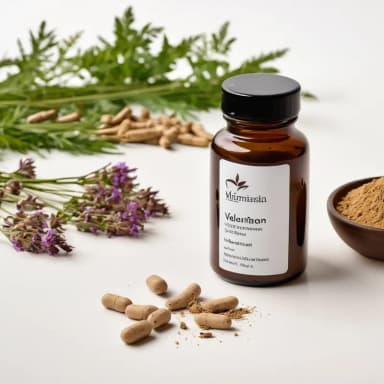
Valerian Root
Valeriana officinalis
Also known as: Valerian, Garden Valerian, All-Heal, Setwall, Radix Valerianae
Valerian root is an herbal remedy traditionally used for sleep disorders and anxiety. Modern research supports modest benefits for improving sleep quality and reducing time to fall asleep, with a long history of safe use.
Introduction
Valerian (Valeriana officinalis) is a perennial flowering plant native to Europe and Asia, with fragrant pink or white flowers and a distinctive strong odor from the root that some describe as "dirty socks" or "sweaty feet." Despite its unpleasant smell, valerian has been used medicinally since ancient Greek and Roman times.
The name "valerian" may derive from the Latin word "valere" (to be strong/healthy) or from the Roman emperor Valerianus. It was traditionally used for a wide range of conditions including insomnia, anxiety, digestive complaints, and as a general sedative.
The root and rhizome contain a complex mixture of compounds including:
- Valerenic acids (valerenic acid, acetoxyvalerenic acid): Primary active compounds that modulate GABA receptors
- Iridoids (valepotriates): Unstable compounds that break down during storage
- Essential oils: Contribute to the characteristic odor
- Alkaloids and amino acids (including GABA itself, though its bioavailability is questionable)
Valerian is primarily used for:
- Insomnia: Improving sleep quality and reducing time to fall asleep
- Anxiety: Modest evidence for reducing anxiety symptoms
- Restlessness: Calming nervous excitability
The mechanism of action appears to involve modulation of GABA (gamma-aminobutyric acid) receptors in the brain. Valerenic acids inhibit the breakdown of GABA and may have direct binding to GABA-A receptors, though the exact mechanism is still being studied.
Clinical evidence is strongest for insomnia, with several randomized controlled trials showing modest improvements in sleep latency (time to fall asleep) and perceived sleep quality. However, results are not consistent across all studies, and effects may take 2-4 weeks to become noticeable.
For anxiety, evidence is more limited and mixed. Some studies show benefits comparable to low-dose benzodiazepines, while others find no significant difference from placebo.
Valerian is generally recognized as safe for short-term use, with few side effects and no morning "hangover" effect that is common with prescription sleep medications. However, the strong odor can be off-putting, and extract quality varies significantly between products.
Main Benefits
Improves sleep quality and reduces time to fall asleep; several RCTs show modest benefits for insomnia without morning grogginess.
May reduce anxiety symptoms; some studies show benefits comparable to low-dose benzodiazepines, though evidence is mixed.
Generally well-tolerated with few side effects; no significant "hangover" effect compared to prescription sleep medications.
Traditional use for restlessness and nervous excitability; calming effects on the nervous system.
Mechanism of Action
Valerian's mechanisms of action involve multiple pathways affecting GABAergic neurotransmission and potentially other neurotransmitter systems:
- GABA Receptor Modulation: The primary proposed mechanism involves interaction with GABA-A receptors:
- Valerenic acids and derivatives appear to bind to GABA-A receptor subunits
- May act as GABA receptor agonists or positive allosteric modulators
- Increases GABA availability in synaptic cleft
- Results in inhibitory neurotransmission and calming effects
- GABA Transaminase Inhibition: Valerenic acid inhibits GABA transaminase, the enzyme that breaks down GABA:
- Increases GABA concentration in the brain
- Prolongs GABA's inhibitory effects
- Contributes to anxiolytic and sedative effects
- Direct GABA Content: Valerian root contains small amounts of GABA:
- Unclear how much crosses the blood-brain barrier
- May contribute to effects through peripheral mechanisms or gut-brain axis
- Adenosine Receptor Interaction: Some valerian constituents may interact with adenosine receptors:
- Adenosine promotes sleep and relaxation
- May contribute to sedative effects
- 5-HT5A Receptor Interaction: Some research suggests interaction with serotonin receptors:
- May modulate serotonin signaling
- Could contribute to anxiolytic effects
- Synergistic Multi-Component Effects: Unlike single-compound drugs, valerian contains multiple active compounds that may work synergistically:
- Valepotriates (though unstable)
- Essential oils with sedative properties
- Lignans and flavonoids with potential CNS effects
Pharmacokinetics: Valerenic acid is absorbed after oral administration and reaches peak plasma levels within 1-2 hours. Elimination half-life is approximately 1-2 hours, though subjective effects may last longer. Repeated administration may lead to accumulation and enhanced effects over time.
Natural Sources
Valerian root comes from the Valeriana officinalis plant. The root and rhizome are harvested and dried for medicinal use. Fresh root has extremely strong odor. Not consumed as food; used only as herbal medicine. Native to Europe and Asia but cultivated worldwide.
Examples:
Valerian root (dried)
Valerian root extract (standardized)
Valerian tea
Valerian tincture
Not consumed as food; medicinal herb only; widely available as supplement; strong odor limits palatability.
Recommended Daily Intake
No established RDA. For sleep: 300-600 mg extract (standardized) taken 30 minutes to 2 hours before bedtime. May take 2-4 weeks for full effects. For anxiety: 120-200 mg 2-3 times daily. Dried root as tea: 2-3 g steeped in hot water.
Effectiveness for Specific Focuses
Primary indication; strongest evidence base; several RCTs support sleep benefits; traditional use for insomnia.
Moderate evidence for anxiety; mixed results; may help mild anxiety but not as consistently effective as for sleep.
Safety Information
Potential Side Effects
Headache
Dizziness
Morning drowsiness (rare)
Stomach upset
Vivid dreams
Contraindications
Pregnancy and breastfeeding (insufficient safety data)
Surgery (discontinue 2 weeks before)
Liver disease (rare toxicity reports)
Overdose Information
Generally safe; rare case reports of liver toxicity at very high doses; no serious overdose typically reported.
Very safe at recommended doses. Long history of use without serious toxicity.
Interactions
Drug Interactions:
Sedatives (additive effects)
Benzodiazepines (additive effects)
Barbiturates (additive effects)
CNS depressants (additive effects)
Alcohol (additive sedation)
Significant interaction with all sedatives; additive CNS depression; avoid combining with prescription sleep medications or alcohol.
Other Supplement Interactions:
Other sleep aids (additive effects)
St. John's wort (may interact)
Kava (additive sedation)
5-HTP (additive effects)
Caution with other sedating supplements; avoid combining multiple sleep aids.
Do not combine with alcohol or prescription sedatives. May cause drowsiness— avoid driving or operating machinery. Discontinue 2 weeks before surgery. Strong odor is normal and not a sign of spoilage.
Forms and Bioavailability
Valerian available as dried root, standardized extracts, tinctures, and teas. Standardized extracts (0.8-1% valerenic acids) preferred for consistent dosing. Quality varies significantly between products.
Standardized Extract (0.8-1% valerenic acids)
Concentrated extract with standardized valerenic acid content; consistent dosing; most studied form.
Well-absorbed; consistent potency; clinical evidence supports efficacy.
Look for 0.8-1% valerenic acids standardization. Use 300-600 mg before bed. Most reliable form.
Dried Root (Tea)
Traditional preparation; variable potency; strong odor and taste.
Variable valerenic acid content; traditional use supports efficacy; less convenient than extracts.
Use 2-3 g dried root steeped 10-15 min. Strong odor. Less convenient but traditional preparation.
Tincture
Alcohol extract; rapidly absorbed; flexible dosing.
Good absorption; traditional preparation; easy to adjust dose.
Use 1-2 ml (1:5 ratio) before bed. Contains alcohol. Convenient for adjusting dose.
Warnings & Suitability
Did You Know...?
Valerian attracted so many cats in medieval Europe that it may have been used by apothecaries to lure and catch neighborhood cats. The root contains compounds similar to catnip actives.
During World War I and World War II, valerian was used to treat shell shock and nervous stress in soldiers under the name "Valyl."
The strong odor of valerian root comes primarily from isovaleric acid, the same compound that gives sweaty feet and Parmesan cheese their distinctive smells.
In the 16th century, Galen called valerian "Phu"—likely an expression of disgust at its strong smell, though some suggest it referred to its sound-alike to "phew."
Valerian was an ingredient in the original recipe for Angostura bitters, the famous cocktail ingredient, though modern formulations no longer contain it.
General Scientific Sources
Tags
Content Verification
Content created with AI assistance and reviewed for accuracy. Sources are cited throughout the text.
Last Medical Review: 2/25/2026
Reviewed by: Prodata.cc