
Medical Disclaimer: This information is for educational purposes only and is not intended as medical advice. Always consult a qualified healthcare provider before starting any supplement, especially if you have a health condition or take medications.
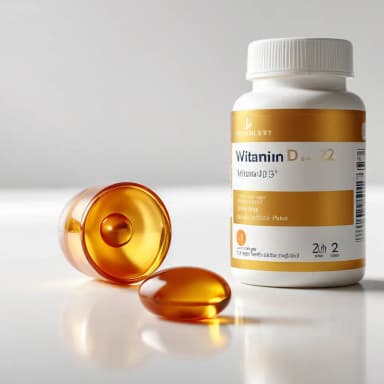
Vitamin D3 + K2
Cholecalciferol with Menaquinone
Also known as: Vitamin D3 and K2 combo, Cholecalciferol + Menaquinone, D3 + MK-7, D3 + MK-4
Vitamin D3 and K2 work synergistically to support bone and cardiovascular health. D3 enhances calcium absorption, while K2 directs calcium to bones and away from arteries through activation of vitamin K-dependent proteins.
Introduction
The combination of vitamin D3 (cholecalciferol) and vitamin K2 (menaquinone) represents a scientifically supported approach to calcium metabolism optimization. Vitamin D3 increases intestinal calcium absorption and maintains serum calcium levels, while vitamin K2 activates matrix Gla protein (MGP) and osteocalcin—proteins responsible for directing calcium to bone tissue and preventing arterial calcification.
This synergistic relationship addresses a critical gap in standalone vitamin D3 supplementation: while D3 increases calcium availability, it does not regulate where calcium deposits. Without adequate K2, supplemental calcium may deposit in soft tissues and arteries rather than bone. Research by Iwamoto et al. first demonstrated that postmenopausal women receiving combined D3 and K2 showed significantly greater improvements in lumbar spine bone mineral density compared to D3 alone.
The two primary forms of K2 used in supplements are MK-4 (menaquinone-4) and MK-7 (menaquinone-7). MK-7 has superior bioavailability with a longer half-life (approximately 3 days vs. hours for MK-4), allowing for more stable blood levels with once-daily dosing. MK-7 at doses of 100-200 mcg has been extensively studied for bone and cardiovascular health.
Clinical applications include osteoporosis prevention, cardiovascular health support, and optimization of vitamin D3 therapy. The combination is particularly relevant for postmenopausal women, older adults, individuals with limited sun exposure, and those at risk of cardiovascular disease.
Main Benefits
Supports bone mineral density and strength through synergistic calcium metabolism. Clinical trials demonstrate superior BMD improvements compared to vitamin D3 alone.
Promotes cardiovascular health by activating matrix Gla protein (MGP), which inhibits arterial calcification and supports vascular elasticity.
Optimizes calcium utilization, directing calcium to bone tissue while preventing inappropriate deposition in arteries and soft tissues.
Supports immune system function through vitamin D3-mediated modulation of immune cell activity and inflammatory responses.
May reduce fracture risk in older adults when combined with adequate calcium intake and weight-bearing exercise.
Mechanism of Action
The synergistic mechanism involves coordinated actions on calcium metabolism. Vitamin D3 undergoes hepatic hydroxylation to 25-hydroxyvitamin D, then renal conversion to active calcitriol. Calcitriol increases intestinal calcium absorption and stimulates production of vitamin K-dependent proteins (VKDPs), including osteocalcin and matrix Gla protein.
Vitamin K2 serves as a cofactor for gamma-glutamyl carboxylase, the enzyme that carboxylates VKDPs, converting them to their active forms. Carboxylated osteocalcin binds calcium and incorporates it into bone matrix. Carboxylated MGP binds calcium ions in arterial walls, preventing crystallization and calcification.
Without adequate K2, VKDPs remain undercarboxylated and inactive. This creates a functional deficiency where calcium absorption is enhanced by D3, but calcium trafficking is impaired. The D3+K2 combination ensures both adequate calcium availability and proper tissue distribution.
MK-7's long half-life (approximately 72 hours) enables accumulation in extrahepatic tissues, including bone and vasculature, providing sustained activation of VKDPs. This pharmacokinetic advantage makes MK-7 the preferred form for most applications.
Natural Sources
Vitamin D3 is found in fatty fish, egg yolks, and fortified foods. The body also synthesizes D3 from 7-dehydrocholesterol upon UVB exposure. Vitamin K2 (MK-4) occurs in animal products (egg yolks, butter, liver), while MK-7 is found in fermented foods, particularly natto (fermented soybeans), and aged cheeses.
Examples:
Fatty fish (salmon, mackerel, sardines)
Egg yolks
Natto (fermented soybeans - richest MK-7 source)
Aged cheeses
Butter and dairy fats
Chicken liver
UV-exposed mushrooms (D2, not D3)
Obtaining therapeutic amounts of both D3 and K2 from diet alone is challenging. Most populations have insufficient D3 levels, and K2 intake is typically low outside of traditional Japanese diets containing natto.
Deficiency Symptoms
Deficiency manifests as inadequate bone mineralization, increased fracture risk, and potentially accelerated arterial calcification. Vitamin D3 deficiency causes rickets in children and osteomalacia in adults. Suboptimal K2 status results in elevated undercarboxylated osteocalcin, indicating impaired bone matrix formation.
Common Symptoms:
Bone pain and tenderness
Muscle weakness
Increased fracture risk
Arterial stiffness
Poor calcium utilization
Vitamin D deficiency affects approximately 1 billion people globally. Suboptimal K2 status is common in Western populations due to low consumption of fermented foods.
Combined deficiency significantly increases osteoporosis and cardiovascular disease risk, particularly in postmenopausal women and older adults.
Recommended Daily Intake
Recommended intakes for the combination follow individual vitamin guidelines. Vitamin D3 RDA is 600-800 IU/day depending on age. Vitamin K AI is 90-120 mcg/day. Clinical studies of combined supplementation typically use 1000-2000 IU D3 with 100-200 mcg MK-7, or 45 mg MK-4 (Japanese osteoporosis protocol).
Effectiveness for Specific Focuses
Primary synergistic benefit. Multiple RCTs demonstrate superior BMD improvements and fracture risk reduction compared to D3 alone.
Strong mechanistic rationale through MGP activation. Growing clinical evidence supports reduction in arterial calcification progression.
Vitamin D3 provides well-documented immune modulation. K2 may have additional anti-inflammatory effects through specific pathways.
May support healthy aging through bone preservation and cardiovascular protection. No direct lifespan extension evidence.
Optimizes calcium and phosphate homeostasis. Some evidence for improved insulin sensitivity with adequate vitamin D status.
Safety Information
Potential Side Effects
Nausea (at high doses)
Digestive upset
Headache (rare)
Skin flushing (MK-4 at high doses)
Contraindications
Warfarin or other vitamin K antagonists
Hypercalcemia
Sarcoidosis or other granulomatous diseases
Severe kidney disease
History of kidney stones (with high calcium intake)
Overdose Information
Moderate risk primarily from vitamin D3 toxicity causing hypercalcemia. K2 has very low toxicity profile.
Excessive vitamin D3 intake can cause hypercalcemia, leading to nausea, vomiting, weakness, frequent urination, and kidney stones. Chronic toxicity may cause vascular and tissue calcification.
Documented Overdose Symptoms:
Hypercalcemia
Nausea and vomiting
Polyuria
Kidney stones
Confusion (severe cases)
Toxicity Thresholds: Vitamin D3 UL: 4,000 IU (100 mcg)/day for adults. No established UL for K2. Studies have used up to 45 mg MK-4 daily without serious adverse effects.
Vitamin K2 has excellent safety profile even at high doses. Risk primarily associated with excessive D3 intake causing calcium dysregulation.
Interactions
Drug Interactions:
Warfarin and vitamin K antagonists - K2 reduces anticoagulant effectiveness
Thiazide diuretics - increased hypercalcemia risk with D3
Orlistat - reduced absorption of fat-soluble vitamins
Corticosteroids - impaired vitamin D metabolism
High risk with warfarin requiring medical supervision. Moderate risk with other medications affecting calcium metabolism.
Other Supplement Interactions:
Calcium - enhanced absorption with D3; K2 directs to bone
Magnesium - required for vitamin D activation
Vitamin A - may compete with D3 at high doses
Generally beneficial interactions. Monitor total mineral intake to avoid excessive calcium loading.
Individuals taking anticoagulants must consult their healthcare provider before using K2 supplements. Regular monitoring of serum calcium and 25(OH)D levels is recommended with long-term high-dose use. Take with fat-containing meal for optimal absorption of both fat-soluble vitamins.
Forms and Bioavailability
Supplements combine D3 (cholecalciferol) with either MK-4 or MK-7 forms of K2. MK-7 is preferred for most applications due to superior bioavailability and longer half-life. D3 is typically sourced from lanolin (sheep's wool) or lichen (vegan). Both vitamins are fat-soluble and best absorbed with dietary fat.
D3 + MK-7
MK-7 has longer half-life (72 hours) and accumulates in extrahepatic tissues. Provides sustained VKDP activation with once-daily dosing.
Superior pharmacokinetics with 8-9x longer circulation time than MK-4.
Most studied form for bone and cardiovascular health. Typical dose: 100-200 mcg MK-7.
D3 + MK-4
MK-4 has shorter half-life and requires multiple daily doses or higher amounts. Rapidly cleared by the liver.
Less bioavailable than MK-7 but effective at higher doses (45 mg protocol).
Used in Japanese osteoporosis treatment at pharmacological doses (45 mg/day).
Vegan D3 + K2
D3 sourced from lichen algae instead of lanolin. MK-7 typically from natto fermentation. Equivalent bioavailability to standard forms.
Comparable absorption to animal-derived forms. Suitable for vegetarians/vegans.
Generally more expensive. Verify third-party testing for potency.
Warnings & Suitability
Did You Know...?
The "K" in vitamin K comes from the German word "Koagulation," reflecting its original discovery role in blood clotting.
Natto, a traditional Japanese fermented soybean dish, contains the highest concentration of MK-7 (approximately 1,000 mcg per 100g).
Vitamin D3 is actually a hormone (secosteroid) rather than a true vitamin, as the body can synthesize it endogenously.
The synergistic D3+K2 concept emerged from Japanese research in the 1990s, where high-dose MK-4 was first used for osteoporosis treatment.
General Scientific Sources
Tags
Content Verification
Content created with AI assistance and reviewed for accuracy. Sources are cited throughout the text.
Last Medical Review: 2/25/2026
Reviewed by: Prodata.cc